ICJ14_05_Krishna_Dharma_ISKCON’s_initiation_system_v4-1
“War! What is it good for? Absolutely nothing.” So sang Edwin Starr back in 1970, when the US was embroiled in the Vietnam conflict. Sadly, his impassioned message seems to have fallen on deaf ears, as we have seen one war after another since then. Hundreds of thousands have died and continue to do so. It is painfully tragic seeing the images of the victims, just going about their lives, and suddenly caught up in…
An accusation I often hear levelled at religion is that it causes so many conflicts. As the recent tragic events unfolded in the Middle East, some have indeed pointed the finger of blame at religion, as at least a factor in the long-standing dispute. Writing for the ‘Big Think’, Adam Lee observed: “…what I do believe is that that it (the Israel Palestine conflict) is being inflamed and prolonged by religious zealotry on both sides.”…
Most of us discover at a fairly young age that the world is not a bed of roses. The carefree joys of childhood were brutally interrupted for me when I was just seven and I lost my mother. Navigating my way through an uncertain world after that, I encountered much more pain in the shape of a less than loving stepmother. It was enough to make me rather circumspect about the prospects of a trouble-free…
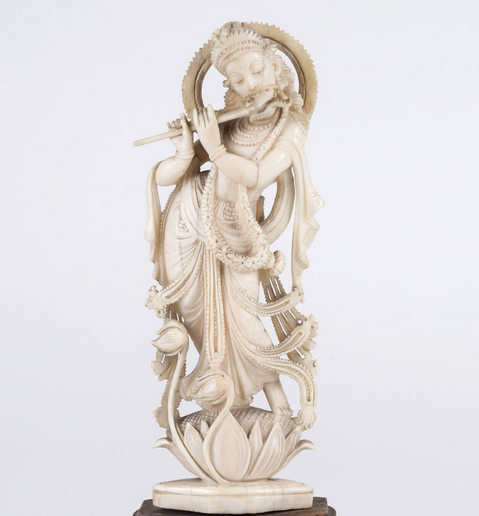
Back in 1972 I was a 17 year-old sea cadet. My ship had docked in Bombay and I stepped onto that exotic shore in search of reasonably priced souvenirs. Under the intense encouragement of a shopkeeper I came close to purchasing a fine ivory chess set costing most of my week’s wages before I spotted a little figurine of Krishna. He exerted a strange attraction over me and after handing over my hard-earned rupees I…
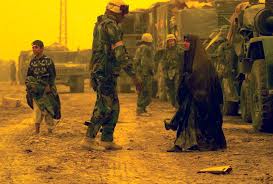
It is interesting that the US and UK style themselves as “liberators” of Iraq. Subtly implied in this euphemistic term is the assumption that we are ourselves already liberated, in a position to bestow our happy state on others. And that is surely a commonly held assumption in the West. We view ourselves as having the most progressive and free societies. But how true is this? A popular newspaper columnist recently wrote a book about…
Dear Srila Prabhupada, Please accept my humble obeisance. All glories to you. Lately, I have been reflecting on my good fortune in meeting your divine grace. Sastra tells us we have been languishing in material existence for countless millennia. I made a rough calculation for how long we in this present age have been around and found it pretty scary. We learn from the Bhagavatam that we jivas are injected into the creation at the…
Perhaps one of the saddest parts about growing up is learning that Father Christmas is not real. I recall a few years ago hearing how a teacher had been hauled across the coals for revealing this terrible truth to his class of six year olds, after outraged parents had bombarded the school with complaints. I was never a big believer in Santa myself. I think it dawned on me at an early age that a…
What if there was one simple solution for all your problems? Something so easy that even a child could do it? Something which costs nothing, is available to everyone and ultimately ends all suffering? Well, before you decide to follow the standard dictum that if it sounds too good to be true then it most likely is, ask yourself a couple of questions. Firstly, do you know who you really are? I don’t mean a…
It seems many of us do not like the government telling us how we should conduct our lives. The current lockdown has elicited vigorous opposition in certain corners of the media, and indeed on many streets around the world. The suggestions that a vaccine may become mandatory, if and when it is eventually developed, will no doubt create even bigger waves of resistance. Professor Ian Philip, a health expert at Sheffield University and government advisor,…
Listening today to a lecture by Srila Prabhupada, my esteemed teacher, I was struck by a brilliant analogy he gave. First, he cited a verse from Vedic literature which basically states that the attempt to improve one’s material situation amounts to nothing more than ‘decorating a dead body’. In other words, the material body is destined to die today or tomorrow. It is always dead, in one sense, as it is only animated by the…
In its most recent survey on the subject of God, the National Centre for Social Research found that some ninety percent of us claim to be believers. One in five even said they had no doubts about God’s existence. Such statistics are perhaps surprising, given that education today tends to steer us toward more atheistic notions such as the’ Big Bang’ and evolution. Surprising also in the face of the widely touted suggestion that religion…
The first question often asked about the Bhagavad-gita is why was it spoken on a battlefield? Despite a common view that religion is a major cause of war, the general view is that the two should remain separate. Religion or spirituality should result in peace not conflict. If one’s spiritual practises bring about the bloodthirsty desire to eliminate the followers of some other faith then they must be suspect. That would surely seem to make…
Purva Raga Dear friend, the trembling of my heart can never find a cure. No herb or medicine or balm, my beating breast can calm. For this disease one remedy will bring relief for sure, but that alas will soon produce painful opprobrium. My friend I am severely struck and all my sense departs, when Krishna’s name enters my ears and lodges in my heart. And then there is another one whose flute enchants my…
1) kadacit kalindi-tata-vipina-sangitaka-ravo mudabhiri-nari-vadana-kamalasvada-madhupah rama-sambhu-brahmamara-pati-ganesarcita-pado jagannathah svami nayana-patha-gami bhavatu me With songs and sweet music, strolling gaily through groves, by the Kalindi. A bee seeking nectar from the lotus-like faces of the gopis. Praising him are Shiva, Brahma, Indra, Ganesh and Goddess Lakshmi. Jagannatha Swami, Lord of all beings, be visible to me. 2) bhuje savye venum sirasi sikhi-puccham kati-tate dukulam netrante sahacara-kataksam vidadhate sada srimad-vrndavana-vasati-lila-paricayo jagannathah svami nayana-patha-gami bhavatu me Sporting fine silken cloth,…
There was once a wicked man of the lower classes. He abandoned all holy rites and gave himself to sin. He had a young wife but also kept a prostitute in his house. The wife, wishing only to please him, served them both. She washed their feet and ate only the remnants of their food. Although the prostitute tried to prevent her she continued to serve that woman in every way, along with her husband.…
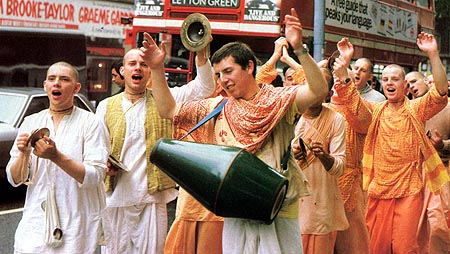
It can be a challenge to maintain your dignity sometimes. I remember when I became a Krishna monk many years ago and donned the orange robes to venture forth on to the streets. Hare Krishna devotees were not a familiar sight at the time, and we would often encounter a spirited response from onlookers, as we sang and danced our way along the road. On one occasion I was showered with a can of beer,…
Love must be one of the most over used and perhaps undervalued words in the dictionary. I’m just as guilty as anyone else, declaring my love for cheese on toast, lying in the sun, or, confession time, Raymond Chandler. In the true sense of the word I wouldn’t say I really love any of those things. For me love means an awful lot more than just liking something rather a lot. Actually in the language…
When I first moved into a Krishna temple, back in the 70s, I discovered that the founder of the Hare Krishna society had dubbed his movement ‘the kitchen religion’. I was somewhat bemused by this – but, as a young man in my 20’s with a keen interest in eating, I was not entirely averse to the idea. And I soon found out the reason for this culinary epithet when, a few weeks later, a…
Officially, the summer solstice is the longest day – almost 17 hours of broad daylight. However, in my experience the length of the day depends largely upon what I happen to be doing. How could I ever forget, for example, those interminable history lessons at school. The clock on the wall all but froze as the teacher apprised us of the fascinating exploits of Oliver Cromwell and his gallant roundheads. Thankfully I am no longer…
Curious to see if I was an authentic Brit I recently attempted the Life in the Uk test that the government requires aspiring new British citizens to take. To my great relief I passed it with 90%, only falling down on a question of how long was the hundred years war. I can’t see many people knowing that it was actually 116 years nor indeed how relevant to being British that knowledge is. I would…
In the halcyon days of my youth I was a bit of a rock fan. As well as permanently damaging my ear drums, it has left me with a head full of various song lyrics hollered out to the strains of rapid fire guitar and pounding drums. One such line I recall was an old blues song covered by Cream, where Jack Bruce declaimed that, “If it wasn’t for bad luck I wouldn’t have no…
It isn’t always easy to see the funny side of things. Often I find it happens in retrospect. Recently I set off for a trip to that fabled land of chocolate and respected home of the European Union, Belgium. After loading up my trusty Satnav with the appropriate maps, I struck out by road. All went well until I approached my destination and it became apparent that the old satnav was struggling. It had taken…
One of my favourite quotes is from the business mentor Stephen Covey, who said that the main thing is to keep the main thing the main thing. In other words, don’t lose your focus. To achieve that of course, I need to have a clear aim in life on which to focus. For many years I grappled with that, not being altogether clear what I was trying to achieve beyond survival and hopefully a bit…
My trip to India brought a few surprises. It’s been some years since I was last there and things are changing fast. The cities are still the same bustling mess of teeming madness, much like anywhere else I suppose, but it’s in the outlying rural areas that I was most shocked. In my many visits to India I’ve always headed straight for a small village called Vrindavan, the most sacred place for Hindus where Krishna…