06.18.10
Posted in Recent articles at 11:20 am by Krishna Dharma
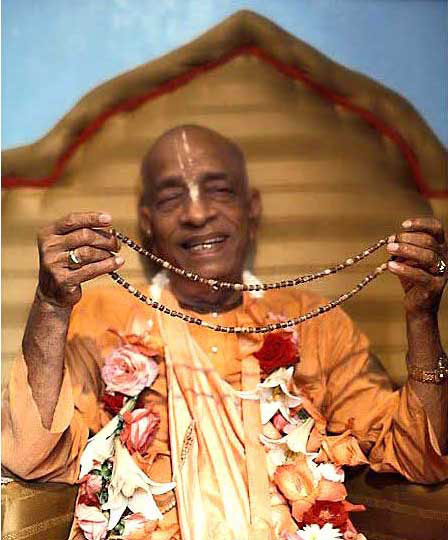
Once Srila Prabhupada was in discussion with a scientist who was averring that nature was the cause of all phenomena. “Why do you propose a God?” he asked. Prabhupada replied, “But when you say nature you must also say whose nature. It cannot exist independently”
It is an interesting point. We all have different natures, but who has this vast and wonderful nature we see all around us?
On a different occasion he faced another philosopher who said that everything was formed from an eternal impersonal energy, again asserting that there was no need to introduce any God. Prabhupada said, “Energy means there must be an energetic source, it cannot stand alone.”
This is a verifiable truth. Heat, light, sound – any energy must always have a point of emanation, a source. So what is the source of the total material energy? Prabhupada gave the answer. “That is God.”
Obvious points to some perhaps, but sadly they seem to often elude even the brightest among us. It was therefore refreshing when Prince Charles in a recent speech attributed our current environmental crises to a “deep, inner crisis of the soul.” Suggesting that we were becoming “de-souled” by consumerism, he said that the problems we now face cannot be solved simply by green technology. It required something deeper, a return to spiritual teachings.
As the poet Wordsworth said even 200 years ago, “The world is too much with us, late or soon.” The spiralling rate of consumerism is driven by an obsession with improving our worldly conditions, an insatiable material greed, both from the consumers and from those who would supply them. It is surely not sustainable no matter how hard we try to move to renewable sources. The New Economics Foundation calculated that if the whole world today consumed at the same rate as the US it would require over “5 Earths” to keep up the supply.
And that is the way it is going. Much of the ‘undeveloped’ world would very much like to have the wealth and amenities enjoyed by the affluent West, and are working hard to get them. Thanks to the all-conquering TV and film industry, even the remotest of places can stare goggle-eyed at a lifestyle that seems to offer a thousand times more enjoyment than theirs.
It is an illusion of course. Happiness will never come from “getting and spending”, as Wordsworth put it. All that will do is agitate the heart and mind, push us to higher levels of anxiety as we hanker for more and more commodities – stuff that somehow never seems to give us the satisfaction and contentment we crave. Obviously. Otherwise how would the free market survive? It runs on the principle that the consumer will always want something new, “a bigger and better illusion” as one rock singer put it.
Surely it is time then for those spiritual teachings mentioned by Prince Charles. Unless we connect with the soul and indeed the Supreme Soul, we will be helplessly driven by our material desires. We must recognise the spiritual in the world and in our selves. The nature we want to exploit and enjoy does not belong to us, it belongs to God, and so do we. Everything is divine energy. Only when we realise this truth and try to act on it, engaging all things in the service of God according to his desire, will the fever of materialism subside, making way for real happiness.
At the moment the fever is threatening to become an epidemic. Prince Charles pointed out that the world population, currently approaching 7 billion, will be some 9 billion by 2050. Allowing for the rapid global spread of TV and other digital media, all pumping up demand for all those nice shiny items the media companies are also selling, there is no chance that even renewable sources will be able to meet the demand, as the Prince suggests. Something has to give.
Prabhupada actually said that the Earth can maintain any number of people, at least in terms of food. I am not sure he meant that every household could have two cars and six TV’s though. He also said that nature has her own way of adjusting problematic situations, such as a population gone mad with frenzy to lay waste her resources in the shortest possible space of time.
So let’s take Prince Charles’ advice seriously. Seek the divine within and without, find peace and bring down the material fever before it goes right off the Richter scale.
Permalink
03.07.10
Posted in Recent articles at 8:30 am by Krishna Dharma
“The only constant is change.” In this world that is certainly true. Nothing stays the same, not even for a moment. All things are forever moving from one state to another. In the case of political parties and leaders that often seems to be from a state of grace to one of disgrace. Sooner or later we will inevitably tire of them and elect someone else.
Those therefore hoping for election often campaign on the word ‘change’. “Change we can believe in,” was Barack Obama’s rallying cry, and now here in the UK the Conservative party are urging us to “Vote for Change.” Even Prime Minister Gordon Brown at the recent Labour party conference declared that his party would be the “change makers” for the “many and not the few”.
It’s a good platform. We all want change, an improvement to our present situation. It is a rare person who is content. Most of us are striving to make things better, our finances, job, homes, health, relationships, peace of mind or whatever. It seems to be human nature to be dissatisfied with our lot, no matter how good it may be.
What do we really want though? What are we looking for? When will we finally stop struggling to change our lives? According to Vedic wisdom we are trying to get back to our original true nature, which is eternal, blissful and full of knowledge. However, we face an uphill battle as this world is described as being intrinsically the very opposite; temporary, miserable and full of ignorance. Hence science, technology, industry, indeed human endeavour in every field never ceases to embrace change as we strive to attain the unattainable.
No matter how hard we try to secure our situation and make it permanent, through building solid houses, good healthcare, strong defences and whatever, eventually everything will fall apart and we ourselves will die. “All valiant dust that builds on dust.” We may work hard to achieve a state of uninterrupted bliss, but it will be always marred by the onset of diseases, anxiety, disasters, wars, and an inventive array of miseries we inflict upon one another. And our endeavours to attain knowledge will be never ending, for there is no end to our ignorance. As it is said, the more we know the more we realise we don’t know. But we want to know. Information or knowledge - the ‘news’ - is thrust at us from all sides these days, day and night. It seems we can’t get enough.
Leaders then have a real struggle on their hands to satisfy the people they lead. Unless, that is, they base their policies upon an understanding of our real spiritual nature, and how we can be restored to that happy condition.
This knowledge is given in the Bhagavad-gita. First of all Krishna explains that the main change confronting us is the changing body. It is constantly transforming and bound for ultimate destruction, but the soul, the person within, is not. Through all the external changes the soul remains the same. We all have experience of our body growing through so many stages, but we know that we are still the same person. Knowing this unchanging person is self-realisation, or realising our true nature.
That is the change we need, that our leaders should lead us toward; changing our consciousness. Right now we are absorbed in bodily consciousness, identifying with so many temporary designations that pertain only to the destructible body. Hence we suffer, as we also identify with all the miseries that attend the body. It is only when we are free of this false consciousness that we become free of suffering, which means reinstated in our constitutionally joyful condition.
We are not meant to suffer, and hence our never ending battle to overcome misery in all its unwanted forms. Leaders always claim that they will somehow alleviate our suffering and increase our happiness, and allured by this promise we give them our vote. But until they understand how to move us toward pure spiritual awareness they will always fall short on their promises.
They need only turn to the Gita. Krishna explains that we can attain our spiritual nature by approaching him, the Supreme Spirit. One Vedic text says, “Come out of the darkness and into the light, out of ignorance and into knowledge.” Krishna is compared to the brilliant sun and when we approach him the darkness of ignorance and forgetfulness is completely dissipated. Just as the sunlight purifies all contamination so the brilliance of God purifies our contaminated consciousness and we shine forth as our eternal ecstatic selves.
How to make such an approach is also explained by Krishna. “Do everything as an offering to me, for my pleasure, while always thinking of me.” That’s Krishna’s campaign slogan. A bit different from the usual message of course, which always entails somehow increasing our own pleasure, but that’s the point, before we can please ourselves we need to know who we are. If we are not the changing body there’s no point simply trying for bodily pleasure. As eternal beings we are a part of the Supreme, and his pleasure is automatically ours. The closer we get to Krishna the closer we get to our real self, our eternal identities as pure spiritual beings, full of bliss and knowledge.
Somehow I doubt that our leaders’ enthusiasm for change will encompass any change in consciousness. Except that we become conscious of their undoubted eligibility for our vote. But until they incorporate Krishna’s message into their manifestos we will be voting for more of the same, changing only from one state of dissatisfaction to another.
Permalink
12.24.09
Posted in Recent articles at 7:50 am by Krishna Dharma
As the commercialism of Christmas increasingly swamps its spirituality, the season has become for many of us an orgy of indulgence. Food, drink and wall to wall TV are the order of the day, with not much remembrance of the central point of the festival, Jesus Christ.
It is not just Christmas, of course, but holidays in general have largely lost their holiness and are now mostly about fun and more fun. Sadly, though, the satisfaction we seek remains ever more elusive when pursued only through bodily or mental gratification. As well as a bonanza for the shops, Christmas brings a flood of business for counselling help lines and all too often the emergency services as too many of us go right over the top.
Glutting our senses will never lead to the lasting happiness we crave, for the simple reason that we are spiritual beings different from the material bodies we inhabit. We are meant for spiritual happiness which is only achieved by connecting with the divine. Pascal spoke of a God-shaped hole in our consciousness and it can only be filled by God. No matter how much we cram ourselves with sensual pleasures we still hanker for something more.
But finding real happiness is easier than we think. It lies within us all if we only take the time and trouble to look. Every scripture tells us that practising spiritual life brings the greatest joy – far greater than any mundane enjoyment.
This Christmas then, instead of surrendering to another bacchanalian blow-out, why not use the time off to bring a little more spirituality into our lives? Remember the life and teachings of pure souls like Jesus Christ. Then we will surely have a truly happy, and perhaps rather less expensive, Christmas.
Krishna Dharma, Hare Krishna Temple, Aldenham
(Watford Observer 24/12/09)
Permalink
12.16.09
Posted in Recent articles at 1:43 pm by Krishna Dharma
If we have to take birth again in this world there are some places we might prefer over others. Ireland, for example, would be a good choice. In that fine land abortion is mostly illegal, giving you a fair chance of emerging from the womb in one piece. But not everyone is happy about that.
Recently three women went to the European Court of Human Rights to challenge Ireland’s 150 year old abortion laws. All three had been obliged to travel to England to terminate their unwanted pregnancies, an odyssey which they claim “stigmatized and humiliated” them. It is set to become a landmark case and some big hitters in the ‘pro-choice’ camp have rallied to their side, including the British Pregnancy Advisory Board (BPAS), whose spokesperson Patricia Lohr said, “There is never any moral justification for the law to place a barrier between women and medical care.”
“Medical care” is of course how the case is being presented; that without abortions many Irish women are risking their health and even their lives. The Irish government contests these claims, saying that where life and limb are at risk, abortions are allowed, but their main argument centres on the risk to the lives and limbs of unborn babies when abortion is freely permitted. In countries where abortion on demand is legal, social considerations far outweigh medical reasons. Mostly it is about undesired pregnancies where contraception has failed or love has gone sour. According to the Guttmacher Institute, the top three reasons for abortion are consistently cited as negative impact on the mother’s life, financial instability and relationship issues.
Women today want to choose whether or not the child they conceived can take birth, and huge numbers are choosing termination. Most estimates put the figure at around 50 million abortions performed each year worldwide. A figure that has steadily increased over the years and looks set to increase still more if Strasbourg sides with the ladies from Ireland.
Vedic teachings would of course go with the Irish government on this one. They say that the first duty of good government is to protect the weak and vulnerable. States which fail in this duty will be “destroyed to the root” according to the Mahabharata, a prominent Vedic text.
On an individual level it is also said that foeticide brings terrible karmic consequences. We get what we give and in our next birth we will find ourselves on the other end of the abortionist’s razor sharp curette. Life is sacred and we cannot whimsically kill others, especially those entirely dependent upon us, because they are “negatively impacting” on our lives.
Abortion is an attempt to ensure our own happiness without any care for the cost to others. It is born out of faithlessness. Every religion proscribes such killing and prescribes sanctified marriage. Have sex within marriage and take care of the children is the message of all faiths. Instead we want free sex, and when we find there is going to be an unwanted price we want to somehow rub it out.
The Vedas tell us that life is present from the moment of conception and the child in the womb certainly has rights, which it cannot defend. As Ronald Reagan said, “Abortion is advocated only by those who have themselves been born.” The mother may fear that her life opportunities are threatened by the impending birth, but what about the baby? He also desires happiness, but he faces a horrific fate, perhaps simply to enable his mother to further her career.
Killing human beings is usually considered murder and even abortionists will admit that unborn babies are humans. Dr. Arnold Halpern, former director of a Planned Parenthood abortion clinic in the US, said, “There is no difference between a first trimester, a second trimester, a third trimester abortion or infanticide. It’s all the same human being in different stages of development.”
Life and death are in God’s hands. No one has any power to breathe life into a dead object, nor has anyone the power to resist death when their time comes. Krishna is in control. Anxiety and suffering come when we forget this truth, when we think ourselves to be in control and we ignore divine direction. We then make whatever adjustments we imagine will bring about our happiness, such as killing our unwanted children. The result will be nothing but suffering—in this case 50 million terrible deaths each year, untold depression and trauma, and then comes the karma.
Let us hope then that in Strasbourg the muted screams of countless babies do not fall on deaf ears, that sense prevails and this grand scale moral and legal anomaly is not endorsed in the name of human rights. God save Ireland.
Permalink
09.02.09
Posted in Recent articles at 1:43 pm by Krishna Dharma
There are almost 2.5 million people unemployed in the UK. Those at least are the official figures. Over 7% of the workforce. It’s become a job in itself just looking for a job. Even the most qualified find it hard with one in ten graduates still failing to find a job a full year after graduating.
Economists and politicians will point to a host of possible causes, but Srila Prabhupada suggested that one main reason for labour not working might be our ‘labour saving’ technologies. “You have created a machine that can do the work of fifty men and now those fifty men are unemployed. Is this progress?”
Well, that’s how most of us see it. I guess it depends upon your paradigm. If you believe life to be about bodily enjoyment then you will likely view work as a bit of a problem. You want to free up time to relax and do things you enjoy, which is not usually work. Then there is the all important profit motive. If a machine is cheaper than manpower then that manpower will find itself added to the jobless stats. And so it is that a great welter of machinery has come into being, along with an equally huge mass of idle persons.
But has it made us happier? This is surely the critical question. For those in the dole queues the answer is not likely to be yes. ‘Unemployment depression’ is a recognised condition. And where work is scarce many of us are forced to do jobs we detest; again hardly a formula for a happy life or indeed a better society. Mark Twain observed that “the fellows who groan and sweat under the weary load of toil they bear never can hope to do anything great. How can they when their souls are in a ferment of revolt against the employment of their hands and brains? The product of slavery, intellectual or physical, can never be great.”
It is not only the direct misery of having no work or work you hate that is problematic; there is also the question of how to support those millions of out of work people. It certainly doesn’t make for easy economics. Still more social issues arise from the old idiom that an ‘idle mind is the devil’s playground’. With increasing numbers of unengaged and bored young persons hanging around on our streets, trouble is sure to follow. Especially when they become desperate for the cash they cannot earn.
The Vedic paradigm works on the assumption that human life has a higher spiritual purpose; that we are meant for self realisation. Actual happiness is derived from this direction, from inner contact with the spiritual, rather than from external sense pleasure. With such a paradigm and its attendant culture there is far less need to advance technology in order to increase material comfort. Those who are happy within themselves are less concerned with their worldly situation. Srila Prabhupada called this ‘simple living and high thinking.’
The simple life of Vedic society means one closer to the land; an agrarian lifestyle where most people grow their own food within local economies. We can easily produce everything we need in this way. The basic requirements of the body are analysed as eating, sleeping, mating and security, and these can be obtained without excessive hard work. Prabhupada would often point out that the animals have no industry and technology but still they obtain all the same necessities as us simply by nature’s arrangement. Life used to be like that everywhere, with everything produced more or less locally by local farms and traders. In many parts of rural India still one will find such a lifestyle where people hardly travel beyond the few villages in their immediate locality. And they certainly seem happy enough.
But human society is fast moving away from this kind of life. Local economies are being swallowed in the engulfing tide of globalisation. Great corporations and conglomerates are producing all our necessities, as well as a whole heap of not so necessaries, and all we can do is try to get a job with them so we can get the money to buy all that stuff. We find ourselves completely at their mercy in so many ways, dependent on fragile infrastructures and supply chains, along with volatile market forces controlled by cash hungry investors.
All this so called progress over the centuries has been driven by the belief that we can somehow improve our material sense pleasure. Atheism and a failure of religion to give people a real spiritual taste lies at its heart. It has been the march of ‘civilisation’ which Prabhupada simply dismissed as “sophisticated animal life”. Virtually all human endeavour now is about advancing material facilities. The idea that life is meant for self and God realisation is all but gone, along with the wonderful experience of pure spiritual happiness, far superior to any worldly joy. But only when we rediscover this spiritual pleasure can we reverse the materialistic trend that appears headed for disaster.
And it surely does seem that disaster looms. Unemployment with its attendant difficulties is just one of many social problems we have created. A host of environmental issues coming out of our new technologies now threaten our happy lifestyle, which is anyway not that happy with those pesky depression figures heading ever upward. In the UK, child and mental health service caseloads have risen over 40% over the last three years. One in ten 1 – 15 year olds has a mental health disorder and the UK has one of the highest levels of self harm in Europe. This has contributed to more and more alcohol and substance abuse and dependence. In Britain this alone costs around £39 billion per year. Then there is global poverty and starvation due to one side of the world exploiting the other for its resources. Meanwhile, in the bloated and spoiled developed world another burgeoning problem is family breakdown. In its report ‘Every Family Matters’, the Centre for Social Justice (CSJ) stated that one in three children born in the UK today will experience parental divorce. Which of course leads to so many other issues. And so it goes.
There is a crisis on our streets. In a recent speech to the Charities Parliament, the chairman of the CSJ, Iain Duncan-Smith said, “You are working in communities without hope. It is not that they have even known hope and had it taken away. Rather, the people in the communities you work with are quite literally without hope: they are hopeless.”
Prabhupada once said that in modern society we first of all put ourselves into anxiety and then we struggle to get out of it. “That is your heroism”, he said.
In a properly functioning Vedic society, examples of which are now very hard to locate, everyone is engaged according to their particular qualities, doing what they enjoy and can do well. There is no jostling for promotion and ever increasing salaries. People are satisfied due to their spiritual practise and they understand life’s goal, which is not ephemeral material pleasure and security, but eternal spiritual happiness. A house built upon rock rather than sand, as one Jesus Christ advised a long time ago.
It is a simple formula. Krishna says in the Bhagavad-gita, “Grow food, worship me and work for my pleasure. Thus you will be happy in this life and the next.” It is time we put it to the test.
Permalink
08.23.09
Posted in Recent articles, Uncategorized at 7:47 am by Krishna Dharma
Among the many gifts the West appears intent on bestowing upon the rest of the world – such as TV, burger bars, pop music etc — democracy is perhaps top of the list. We cherish our democratic institutions and are prepared to endure great pain and difficulty, sacrificing our soldiers and heaps of cash, to ensure that voting is embraced in far flung places like Iraq and Afghanistan. Even, it seems, when they don’t really want it anyway. The recent elections in Afghanistan were very poorly subscribed, with many polling stations remaining more or less empty. At a gathering on polling day of many tribal leaders from all around the country a Sky journalist asked them why. They unanimously responded by saying that they were happy enough with their own way of doing things and resented Western interference. This, they said, was the general view of the people.
Nevertheless the voting went ahead and a leader was elected, one with which the West no doubt hopes to ‘do business’. But what of democracy? So called power to the people. Does it really work? Certainly it is not propounded by the Vedas, where theistic monarchies are the general model encouraged. They are hardly in fashion these days, but is democracy that much better?
Apparently so, as it seems we are free to make a choice about who rules over us, and we are unlikely to select candidates who look like they will make life unpleasant. Well, who at least promise us very sincerely that they won’t.
How free though is our choice? Obviously we must form our views based upon the available information, and that is often presented by those who would seek our vote. Consider this from Herman Goering. “Naturally the common people don’t want war; neither in Russia, nor in England, nor in America, nor in Germany. That is understood. But after all, it is the leaders of the country who determine policy, and it is always a simple matter to drag the people along, whether it is a democracy, or a fascist dictatorship, or a parliament, or a communist dictatorship. Voice or no voice, the people can always be brought to the bidding of the leaders. That is easy. All you have to do is to tell them they are being attacked, and denounce the pacifists for lack of patriotism and exposing the country to danger. It works the same in any country.”
There spoke a man who knew a bit about manipulating public opinion. And have things changed? Constantly we encounter a barrage of ‘news’, views and ‘expert’ opinions, all of which shape our outlook and hence who we choose as our leaders.
Which is fine if our outlook is enlightened and we are able to recognise a truly qualified person, one who will lead us on to the promised (by them) land of milk and honey. But how well are we making that call? Are the politicians and leaders who culled our votes living up to our expectations? How often are we disappointed?
Winston Churchill once said, “the best argument against democracy is a five minute conversation with the average voter.” This was a point Srila Prabhupada often made. Leaders must be selected by the most qualified persons in society; those who know the goal of life and how to attain it. In Vedic society, although the feelings of the people were not ignored, it was always the pure-hearted sages and Brahmins who were chiefly consulted in matters of who should lead the state. Prabhupada said, “if you ask a criminal or a drunkard to vote for a leader then what can you expect?”
It is a bit like asking a young child to vote for his parents. Most kids would like a mum and dad who let them more or less live on chips and chocolate, take very few baths, chill out all day and never attend school. What a life. But mum and dad know better, and in the same way the state leadership, according to Vedic wisdom at least, should also know what is best for the citizens.
Great sages know that life has a higher purpose than simply satisfying the bodily senses like the animals. They know that true happiness comes from realising our spiritual nature as eternal parts of the Supreme. And they know that real care for others is demonstrated not by indulging them with whatever they immediately want, but by training them toward the goal of ultimate and everlasting peace and happiness.
Perhaps in the absence of too many enlightened seers we are safest sticking with democracy for now, but whether elected by the people or selected by the spiritually advanced sages, leaders have a grave mission to perform. Prabhupada says, “The kings or the executive heads of all states must fulfill the mission of human life, which is to make an end to all miseries of material conditions.”
And chief among those conditions of misery is repeated birth and death. So let’s see, whose manifesto promises to end that?
Permalink
01.10.09
Posted in Recent articles at 12:36 pm by Krishna Dharma
Travelers battling through the Westminster traffic this month are likely to encounter a bleak message emblazoned on buses. “There’s probably no God. Now stop worrying and enjoy life,” is the dubious legend plastered to a number of the vehicles meandering around the nation’s capital. I’m not sure how its authors think we should respond to this call. Should we breathe a sigh of relief and immediately rush off to engage in all sorts of licentious behaviour so long denied us by a killjoy God? That sounds worrying to me, I have to say. Such so-called enjoyment is inevitably indulged in at considerable cost to the world, to others and ultimately to our own selves. Intoxication, illicit sex, stealing, gambling, killing and other such sins generally vetoed by religion are not pursuits we should lightly unleash on the world at large.
What do the proponents of this message mean by ‘God’ anyway? As we know the term is variously interpreted, but if we assume they mean a supreme controller and judge of our acts, then just how probable is his non-existence? It is not very probable that there is no power moving us in ways we cannot prevent. Even scientists, and it was a prominent one who funded the bus campaign, spend their time trying to find and understand the laws of the universe. Laws. Those things that cannot be changed or contravened, which uphold our existence and which obviously must have an upholder. Laws mean a lawmaker, and no matter how proud we may become of our learning and progress, we can never claim to have made any universal laws.
As for a judge, well we have to ask why, despite our best efforts to avoid it, we suffer? All our work aims at one end, to enjoy life and be happy. In accordance with our best understanding of cause and effect we work in ways calculated to produce desirable results, but we often reap a rather a different harvest. So why is that? Honest thought should conclude that we are doing something wrong; that we have not yet properly understood the universal laws and are therefore transgressing them, to our cost.
That does not mean there must be a stern God sitting somewhere in judgment, waiting for us to sin so he can rain down pestilence and death upon us. I can quite understand people wanting to get away from that kind of fierce deity. But as in any state or country, there are laws and consequences that will ensue if we break them. We need those laws. The Vedas say that in the absence of law and order, enforced by good government, then the ‘law of the fish’ will soon prevail. The bigger fish will swallow the smaller one. Honest citizens are therefore happy to see the rule of law in place. It is only criminals who revel in a lawless state.
The message on the bus could well have said, “There is no government. Now go out and party.” But honesty must again intervene to point out that if there is no government the party will soon be over. Governments don’t only enforce law and punish offenders; they also administer and manage the state, keeping things going smoothly (we hope), so we have food, shelter, money and everything else we require if we are to live happily.
Surely then there must be a universal government maintaining the cosmos and providing our necessities. The sun draws water from the ocean, which then goes up to the sky, over the land and rains down on our fields; and we eat. A wonderful system, and one over which we have no control, along with all such perfect universal arrangements. To date no scientist has been able to manufacture even one seed, never mind a sun.
Who is the fool who will suggest that there is no intelligence behind all these intricate universal systems; and that they go on by chance? Day after day they continue working. If chance brought them into being, and if chance is truly supreme and there is no controller, then we should expect no predictability. Everything should run wild with random occurrences popping up everywhere without rhyme or reason. But as we all know that is probably not going to happen. Again, the very point of science is to fathom out the rhymes and reasons behind nature, so we can predict the outcome of our endeavors with some certainty.
But how well are we doing that? Which brings me back to my point above. There is a higher power, let’s call it God, determining the consequences of our work. We are obliged to accept those results and no slogan on any bus can change that. Our best hope is to accept the very high probability of God’s existence, try to properly understand his desires, and then carry them out to the best of our ability. Only then will we truly stop worrying and enjoy life.
Permalink
12.24.08
Posted in Recent articles at 10:40 am by Krishna Dharma
When we send our children to school obviously we hope that they will be taught the truth. Well, at least some of the time. It seems that painful truths may have to wait, such as the non-existence of Santa Claus. A teacher who recently made the grave error of informing children in her class that Father Christmas was not real found herself out of a job. Parents were furious. “My Joshua came home in tears,” said one distraught mother. “I didn’t know what to say.”
We want our children to be happy and with this in mind we send them to school. Without knowledge we will suffer, being unable to get through life very well. Ignorance is the root of misery as it leads us to foolish action or even inaction, and hence to the painful consequences. But what is the best knowledge? What is that understanding which will eradicate all misery, permanently?
Believing in Santa is obviously an illusion, and we have all had to face that terrible truth at some point in our lives. But how many other illusions have we been sold? Have we been given the whole and highest truth? Are we actually becoming free from all our suffering?
Probably not. In fact much of what we learn at school is subject to constant change, especially in the field of science, where new discoveries are always being made and old theories rejected. Which makes all of it highly suspect. The Vedas declare that an important criterion of truth is that it never changes. Two plus two equals four – it always has and always will. This is the test of real knowledge. It is perfect and unchanging.
These days though we are fed theories, such as the “theory” of evolution, as if they were accepted facts. But there are so many different opinions about such so-called facts, ideas are always changing, and there is every chance that in a hundred years from now a whole different theory will have replaced the one we are now obliged to learn.
And all the while we are not taught about a very real fact that we all have to face. The poet Porteus said, “Teach him how to live. And oh! Still harder lesson. How to die.” This is the best knowledge, and the elephant in everyone’s room that we mostly try to ignore. One great Vedic teacher said that we are all “sojourners on the path of death.” Whatever great things we may achieve in life will soon be annulled by the fact of our death. We will not take any of it with us. And where then shall we go? We have no idea. We can guess, hope, or boldly state that we will go nowhere at all, that we will cease to be, but in reality we are in complete darkness.
The Vedas therefore enjoin that this is the first and most important lesson. “Now you have a human life you must inquire into the absolute.” Ask the big questions. Who am I? Why am I here? Where do I go when I die? At least we should dedicate some of our time to seriously investigating these areas of major importance. But what school does that?
Rather we are encouraged to work very hard to improve our material living conditions. Get a better job. Earn more money. Live in a nice house with all the trappings. The Vedas suggest that this endeavour rests on an erroneous assumption, namely that we are the body. We are identifying with the bag of blood and bones that we inhabit, assuming it to be ourselves. But Vedic wisdom tells us we are different from the body, that we are eternal, indestructible parts of the supreme whole or God.
If this is true, and the evidence suggests that it is, then our entire education devoid of spiritual content is selling us an illusion to match that of Father Christmas. What evidence? Just observe how the body changes, from a baby through childhood to adulthood. A complete transformation, but are we a different person? Of course not. We remember our childhood and know that we are the same personality now, despite all the changes. We are something different from the body. And that unchanging person is the eternal soul. When the body makes its final change at death the soul continues. Why not?
This is surely an observable truth, but who is observing it? What lessons do we get in school about understanding our true self? As time goes on we go further away from such teachings, more and more toward material acquisitions, toward any kind of immoral behaviour as long as it satisfies our bodies, which is what we believe we are, and therefore what we think will make us happy. But how can we be happy if we have started with the wrong conception of self? As the ancient Greeks said, echoing the Vedic instruction, “Know thyself.” Only then can we be happy.
Therefore the Vedas say that from the very beginning of life we should be taught spiritual lessons. We do not have to suffer. We are meant instead for eternal life, for unending happiness with the Supreme Lord Krishna in his immortal abode, and the training for this must begin from childhood. Death may come at any time and we must be prepared. Our ostrich–like educational approach has to change. Face up to the elephant. Otherwise we can carry on with Father Christmas. But he may bring us some rather unexpected presents.
Krishna Dharma, Dec 2008.
Permalink
09.30.08
Posted in Recent articles at 10:24 am by Krishna Dharma
It has not been a good year for the world. First we are told about global food scarcity, then we hear of possible oil shortages, and now – horror of horrors – we run out of money. Surely even the staunchest believers in free market capitalism must be beginning to wonder how much longer it can last.
As bank after bank either folds or gets nationalized, and as more and more ordinary people in the street face the prospect of losing their jobs and homes, the inherent weaknesses in our financial system are starting to show. Greed is of course one major problem. Bankers chasing fat profits with high risk gambles that fail. But behind it all there is a deeper issue.
Perhaps the reaction to this crisis by many investors gives us a clue. While the prices of shares and even oil tumbled in the wake of the US decision not to bail out the bankers, one price went up considerably – gold. Good old gold, always a solid investment, unlike the pieces of paper that once represented it, or even worse, digital files on a hard drive.
What is real wealth? According to Vedic knowledge, and surely it should be obvious, real opulence means the earth’s bounty. Grains, vegetables, fresh water, minerals, jewels, gold, and everything else we need comes from mother earth. Not one single factory has been built that can manufacture even one of these items to provide for human society.
Writing in the Srimad Bhagavatam, Srila Prabhupada says, “Human prosperity flourishes by natural gifts and not by gigantic industrial enterprises. The gigantic industrial enterprises are products of a godless civilization, and they cause the destruction of the noble aims of human life. The more we go on increasing such troublesome industries to squeeze out the vital energy of the human being, the more there will be unrest and dissatisfaction of the people in general, although a few only can live lavishly by exploitation.”
Now it seems even the lavish livers are finding it hard, although I expect most of them have adequately insured themselves against the present crises. Certainly though we are squeezing out our vital energy for no profit other than increasing our stress and anxiety levels, with tranquillisers and mood elevators being prescribed and consumed at record levels.
Although essentially a spiritual treatise, the Bhagavad-gita does offer some material advice. “Grow food”, Krishna tells us, and he goes on to explain how that is best achieved by describing the cosmic hierarchy that actually provides our necessities, and how we can work in harmony with it. Perhaps unsurprisingly, huge industrial enterprises, investment banks and all the other trappings of capitalism are not mentioned.
Growing food may seem like unnecessary advice, but increasingly that is not what we do. More and more it is being left to huge agribusinesses to provide food for the world while the rest of us work in a thousand and one other industries. And then market forces, our friends the financiers again, act to complicate the whole business. As a result we have seen huge amounts of produce dumped in the sea while other parts of the world starve.
But while we are seeing headlines about so called global food shortages, there are huge swaths of land everywhere that could easily be employed to produce our food. Often though the insatiable demand for cash steps in and instead of food we see bio-fuels or other useless crops like tea or coffee, or worse still, livestock feed, being grown. And all the while most of us continue to squeeze out our vital energy producing any number of items that, at the end of the day, we really do not require.
And this is Krishna’s real point, as stated by Srila Prabhupada. We are meant to pursue the “noble aims” of life. These are not to unlimitedly increase technology, equipping ourselves with an array of gadgetry in the misguided belief that it will make us happy. The real aim of life is to get free of worldliness and realize our true spiritual nature, beyond this temporary sphere.
Krishna therefore tells us to grow food and get the few basic necessities we require out of the way, then we can concentrate on life’s noble aims, the noblest of which is to know Krishna himself, the Supreme Person with whom we have an eternal loving relationship. That knowledge cannot be achieved by any kind of material progress. In fact the more we become wrapped up in the vain attempt to improve our happiness by material adjustments, by striving for more wealth, then the less we are able to peacefully concentrate on realizing the absolute truth.
But it is a long way back to go from our highly industrialized and urbanized society to the kind of simple living and high thinking proposed by the Bhagavad-gita. Before even attempting that perhaps the first question we should ask is why we moved and are still moving rapidly in the opposite direction. The only answer is that we lost touch with our spirituality. Allured by the promise of spectacular enjoyment proffered by our scientific progress we turned more and more away from the divine. But now we are seeing the result, in our environment, our society and our own hearts, which are always hankering for something more, something we never seem to find.
The time is therefore right to follow Krishna and Prabhupada’s advice. Turn back toward the divine. Give up our frantic pursuit of material possessions and find the real treasure that lies within. A treasure that even the worst economic collapses cannot diminish.
Krishna Dharma
Permalink
08.25.08
Posted in Recent articles at 6:37 am by Krishna Dharma
The All Auspicious Day
Then spangling dark night’s velvet cloak,
in time and place divinely meant,
stood stars in silent lines that spoke
how here is love incarnate sent.
Marking the all-auspicious hour
that for an age shall yet be marked,
predicting that the purest power
has here with us to earth embarked.
Speak, mystic seer of the skies,
that we the wretched joyful be,
how one free from all hate and lies
has come to lead humanity.
And all you gods, let cry with might,
that all the worlds may wakened be,
to gaze with wonder on the sight
of man’s departing misery.
Today forgiveness does descend
to walk among us: Gurudeva.
The thraldom of transgression ends
in freedom that you freely gave.
Until this day shall be proclaimed
in every quarter of the earth,
and every man shall know your name,
we yet shall take repeated birth.
The legend of a long lost land
made real today, as you have shown
how they who take your outstretched hand
shall find it, our forgotten home.
.
O Prabhupada, we can but pray
that you might throw your sidelong glance
on us, and thus, by grace we may
enter the everlasting dance.
Krishna Dharma das
Permalink
« Previous entries